

The True Cost of Long COVID and ME

A joint analysis by Risklayer and the ME Research Foundation, updated in April 2026, has put a price tag on what patients, caregivers, and advocates have long known: these are serious, debilitating conditions with massive consequences not just for individuals, but for all of society.
What the Report Found
The report, which covers the six-year period from 2020 to 2025, concludes that Long COVID and ME cost German society €318.8 billion over six years. In 2025 alone, the combined cost reached €64.4 billion — equivalent to 1.44% of Germany's entire gross national product for that year.
To put that in perspective: the German federal government spent approximately €40 million per year on Long COVID and ME research during the same period. That means research investment amounted to just 0.075% of the annual cost these illnesses impose on society.
At the end of 2025, over 1.4 million people in Germany were living with either Long
COVID or ME:
756,808 people living with Long COVID
656,951 people living with ME (including cases triggered by COVID-19)
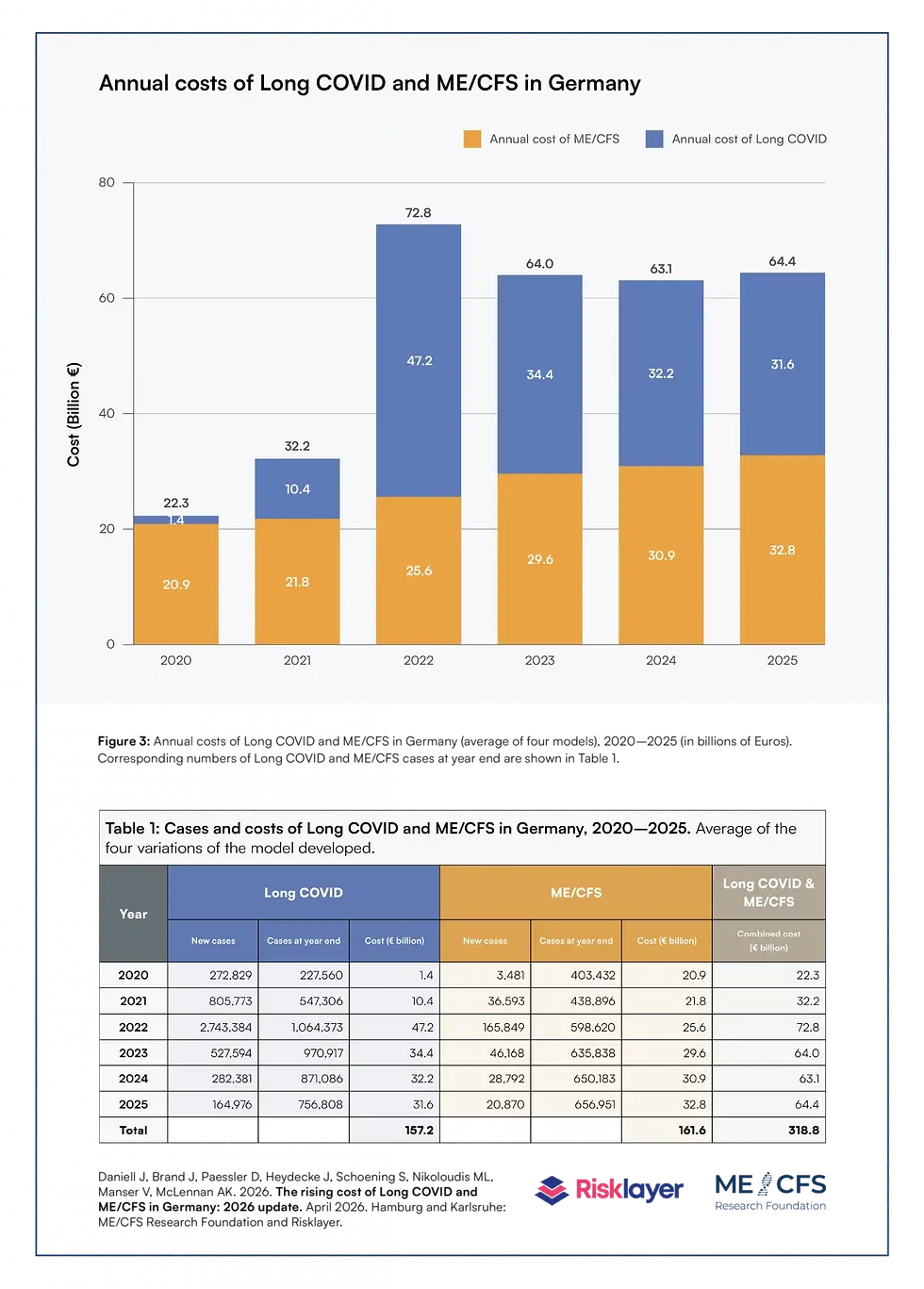
Crucially, the number of ME cases continued to rise even as Long COVID cases stabilized, a finding consistent with what experts have long predicted: that widespread SARS-CoV-2 infection would drive a substantial increase in ME diagnoses worldwide.
Why These Numbers Matter for Canadians
While this report focuses on Germany, the implications reach far beyond its borders. Canada has its own growing population of people living with Long COVID and ME, and similar patterns of:

Underdiagnosis and dismissal by the medical system
Inadequate research funding relative to the scale of the problem
Lost productivity, income, and quality of life for patients and their families
Lack of treatment options, particularly for those with post-exertional malaise (PEM)
The German data offers what Canada currently lacks: a rigorous, quantified picture of what inaction costs. And the message is clear — the longer we wait to invest in research and treatment, the higher the bill becomes.
What the Costs Actually Include
The report doesn't just count doctors' visits. It takes a comprehensive view of the economic damage caused by these illnesses, including:
Production disturbance costs — lost output when people cannot work
Human capital costs — long-term loss of workforce contribution
Medical costs — direct healthcare expenditure
Administrative costs — processing disability claims, benefits, and supports
Quality of life costs — the profound reduction in well-being for patients and caregivers
Support and assistance costs — formal and informal care provided to those who are ill
The model was developed using conservative assumptions, meaning the true costs are likely even higher than reported.
The ME Crisis Within the Crisis
One of the most important findings of this report is the diverging trajectory of Long COVID and ME. While Long COVID cases peaked in 2022 and have since stabilized, ME cases have climbed steadily and show no signs of natural decline.
This matters because ME has an extremely low recovery rate, only around 5%. People who develop ME, whether from COVID-19 or other triggers, tend to remain ill for years or decades. Without effective treatments, the number of people affected and the associated costs will continue to grow.
The report is explicit: "Currently, there is no reason to assume that the high level of costs is going to decrease on its own."
What Needs to Happen
The researchers offer clear recommendations for governments and health systems:
1. Invest in biomarkers, diagnostics, and treatments. The single biggest driver of societal cost is the lack of recovery. Targeted investment in developing safe, effective, and accessible treatments is the most powerful lever available.
2. Close the biomedical funding gap. To date, the vast majority of government research funding has gone toward rehabilitation and psychotherapy — approaches that do not change the disease state for patients with PEM. Only 18% of federal funding in Germany has gone toward biomedical ME research. This imbalance must be corrected.

3. Accelerate research through collaboration. Biomedical, translational, and clinical research need to move in parallel, not sequentially. Platform trials, open science, and patient involvement can all speed the path to treatments.
4. Improve data collection. Better disease surveillance is essential. Without reliable data on infection rates, Long COVID incidence, and ME prevalence, governments cannot allocate resources effectively or measure whether interventions are working.
A Note on What This Means for Patients
For those living with Long COVID or ME, this report is a form of validation. It transforms lived experience into the language that policymakers and health systems respond to: evidence and economics.
Belief is the first step. Being counted is the next. And being properly resourced in research, clinical care, and disability supports must follow.
This report makes clear that the cost of dismissing these illnesses is not zero. It is hundreds of billions of dollars, borne overwhelmingly by the patients themselves.

Comments